The Fuel Store Card

With the conflict reigniting this week, we want to give you more than just a snapshot of today's price. Here's the full story of what's happened to the fuel market since 28th February, why it matters, and what it means for your costs right now.
When the US and Israel launched strikes on Iran on 28th February, Brent crude was trading at around $70 a barrel. Global supply was reasonably balanced, strategic reserves were adequate, and prices had been stable for several months.
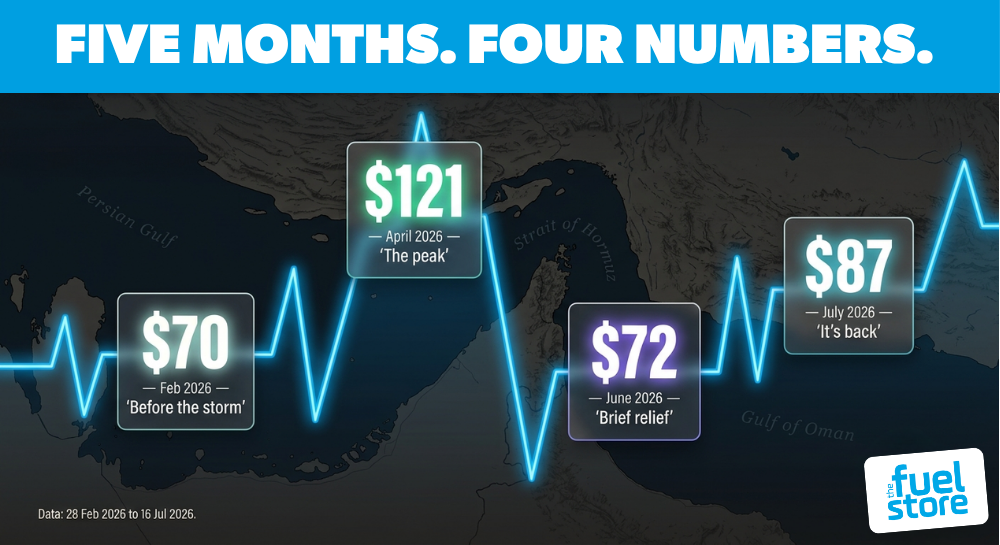
The effective closure of the Strait of Hormuz triggered the largest supply disruption in the history of the global oil market. Around 20 million barrels a day of oil and gas normally transits the strait. Within weeks that had fallen to a fraction of normal volumes. Brent peaked at around $121 a barrel in late April, its highest level since 2008.
Despite the severity of the disruption, supply proved more resilient than many feared. The IEA coordinated a record 400-million-barrel strategic reserve release. Saudi Arabia rerouted exports through its East-West pipeline to the Red Sea. Low demand, particularly in Asia, took some pressure off prices. Those factors combined to put a ceiling on the spike and begin pulling prices lower through May and June.
On 18th June the US and Iran signed a Memorandum of Understanding (MOU) to end the conflict and reopen the Strait of Hormuz. Hormuz traffic began to recover. Brent fell steadily through June, reaching around $72 by the end of the month, close to where it had been before the conflict began. The EIA was forecasting Brent averaging $74 for the third quarter, falling further into 2027 as production recovered.
On Monday 13th July, Iranian forces attacked a Cyprus-flagged container ship, the MV GFS Galaxy, as it transited the strait. The US responded with fresh strikes on Iranian military targets, the start of four consecutive nights of attacks. The US reimposed its naval blockade on Iranian ports on Tuesday 14th July. Strait traffic dropped by more than 50% compared with the previous week. Brent spiked from around $72 back to $86-87 this morning, a move of around 20% in less than a week.
Iran has described the MOU as having entered a "crisis phase." Trump has threatened strikes on Iranian bridges and power plants next week if no deal is reached. The diplomatic track is under severe strain.
The practical position for fleets this weekend is straightforward. Current rates are fixed until midnight Sunday 19th July. With prices having moved sharply upward this week, drawing fuel tomorrow, Saturday or Sunday locks in your current price ahead of Monday 20th July's reset. We'd encourage you to make the most of that window.
The way we purchase fuel is designed to absorb volatility, which works in your favour in both directions. We'll update you again before the weekend is out if anything significant changes. Your account manager is on hand if you want to talk through your account or your options.
If the last few weeks has shown you what unprotected fuel exposure looks like in such a fast-moving market, get in touch. Fixed weekly rates exist to give your business certainty when the market doesn't.